
Introduction
The iPhone is one of the most popular phones ever, thanks in part to Apple's brand being behind it. The Nexus 5, on the other hand, is less well known, and most iPhone or feature phone users will not know of the great bargain it brings; it is still Google's Android flagship, however, just like the iPhone 5s is Apple's phone flagship.
Some people are slightly put off the iPhone 5s by the fact that it is simply a slightly revamped version of last year's model, for more money. I would however say that the difference is great enough, in some respects, to warrant the price increase; in any case, last year's iPhone 5 was by no means bad, but very few phones are as good as perfect. The new iPhone 5s has a new 64-bit A7 CPU/GPU chip, which is claimed by Apple to be significantly faster than the A6 chip found in the iPhone 5, as well as being the first 64-bit chip in a smartphone, in addition to an improved 8MP dual-tone-flash camera, a new Touch ID fingerprint scanner and brand new iOS 7, among other things.
The Nexus 5 is, by contrast, quite different to last year's Nexus 4, though it still carries echoes of it, and certainly continues the trend of improvement, with a much faster, state-of-the-art 2.26GHz quad-core Snapdragon 800 processor, and a pin-sharp 445 PPI 4.95-inch (12.6cm) 1080p Full HD IPS+ touchscreen, an improved 8MP camera with optical image stabilisation and HDR+, plus the latest Android 4.4 KitKat.
So in terms of having lots of upgraded parts, neither of these flagships falls behind the curve. Let's see how they fare in the design department.
Design
 |
| The iPhone 5s |
The Nexus 5, on the other hand, doesn't have a wowing design like the iPhone 5s but its shape, as well as its rubberised, ergonomic back,
is sometimes more grippy, so better if you're worried about dropping your precious device. It also has a less demanding design, and perhaps is less likely to be stolen because it's less eye-catching, as well as being less expensive. Users can perhaps expect a little more privacy, too, because others are less likely to look over their shoulder. That said, it still exudes a certain cool air about it, especially with its exclusive ceramic buttons.
 |
| The Nexus 5 |
This choice very much depends on either you prefer to have a flashy, cool device or a rather ordinary yet cool one - it's rather a personal choice.
Winner: tie
Software
The iPhone 5s runs the brand-new iOS 7, while the Nexus 5 has the latest Android 4.4 KitKat, with both being first to receive any updates because they are the company flagships. These two fiercely competing operating systems both have their pros and cons.
 |
| The new iOS 7 homescreen |
 |
| The new Android 4.4 homescreen |
This is a tricky decision too, because some people decide to go for iOS on account of its ease of use and clarity, while others prefer the possibilities of Android. I would say that features play no role here, for there is no feature that iOS has which is exclusive to it, whereas the opposite is true, i.e. there are some exclusive Android features that iOS does not have. To me, iOS and Android both look good and are easy to use, and thus it is the additional features and capabilities of Android win this one for it, and the Nexus 5.
Winner: Android/Nexus 5
Hardware
The iPhone 5s contains a world-first 64-bit Apple A7 chip, an upgraded 8MP dual-colour-flash camera and a new amazing Touch ID fingerprint scanner. Meanwhile, the Nexus 5 has the awesome Snapdragon 800 chip, another improved 8MP camera with optical image stabilisation and a brilliant Full HD, razor-sharp 4.95" display.
 |
| The new Touch ID sensor |
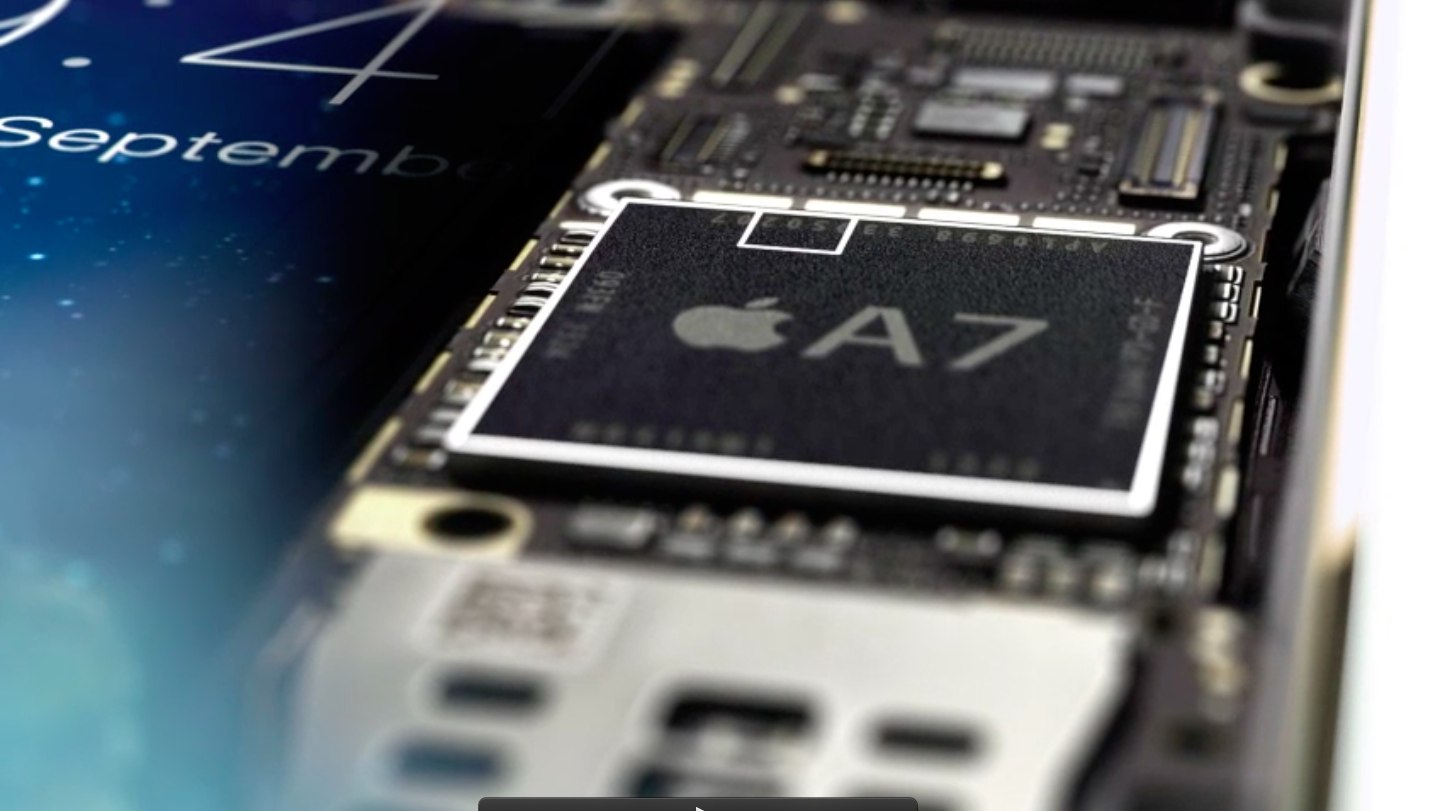 |
| The new 64-bit A7 chip |
 |
| The new Snapdragon 800 chip |
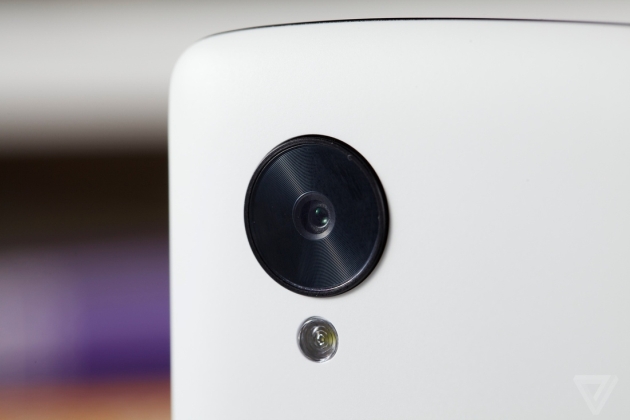 |
| The Nexus 5's camera |
These devices are set apart mainly by their processors, screen, Touch ID/Face Unlock and camera. The winner of the processor battle might be expected to be the 64-bit Apple A7. However, in real life usage, both of these phones are equally fast to a few hundredths of a second, so this one is a tie - despite Apple's more advanced technology, it doesn't really make it noticeably faster (or slower) than the Nexus 5. The winner of the screen battle is most definitely the Nexus 5, because, slight viewing angle difference aside, and although the screens can produce are very similar results in terms of brightness and contrast, the Nexus 5's screen is significantly sharper and larger, especially considering the huge price difference. The inclusion of Touch ID in the iPhone 5s does little to tip the balance either way, because Android has had Face Unlock since 2011. Lastly, the camera round is also fairly close in some respects, because in good light you will get similar results from both devices. In low light the Nexus 5 performs less well, being sometimes slower to focus, and bringing generally dimmer, less contrasting photos. However, this is made up for by its addition of Photo Sphere, as well as Google's Auto Awesome feature, where photos automatically backed up to Google+ Photos are also automatically improved, and you can edit them further very easily and effectively; that, therefore is a tie. The Nexus 5 supports more wireless connection standards than the iPhone, such as NFC, WiFi 802.11ac, Qi wireless charging, WiFi Direct and Miracast, while the iPhone's only trump card is AirDrop, which is just another local file sharing mechanism, matched by NFC and WiFi Direct, so the Nexus 5 easily wins this. Overall then, with three ties and two wins for the Nexus 5, it wins this category.
Winner: Nexus 5
Battery
This one is a slightly split category because it depends on how you measure this: run-flat tests or day-to-day usage.
In run-flat tests, i.e. where an operation is repeated endlessly until the battery runs out, there is one winner. In day-to-day usage, however, it is slightly different. Run-flat tests where I looped the same full display quality (i.e. as high quality as the display can show) video, stored locally on the device, in aeroplane mode but with WiFi on, made the Nexus 5 the winner, enduring about half an hour longer than the iPhone 5s, at six hours compared to five-and-a-half hours. Real-life usage showed that the iPhone 5s lasted slightly longer, being at about 7-13% after a day of medium-to-heavy usage, as compared to the Nexus 5 almost dying, at 1-9% at the end of the day, after similar usage. However, these figures suggest that if you are a heavy user, having a charger around at work or wherever you use your device during the day, may be useful with both devices.
This leaves a slight conundrum for users, because if you are going flat-out, or perhaps a movie marathon, the Nexus 5 would be better because its battery lasted longer, and its screen is more suitable for movies due to its increased size. But if you are an everyday heavy user then the iPhone may be better for you - but if you don't use your smartphone obsessively, then either of these devices ought to last you fine - but will need charging every night.
Winner: tie
Price & Value
This one is a no-brainer really. If you care about your money, then the Nexus 5 is for you. If you don't care about spending your money, then the Nexus 5 is also for you.
Given that the Nexus 5 has won most of the rounds, and/or they have been ties, I think I can say that I find it the better of the two - price aside. So you'd think it was the more expensive of the two. But no: it costs just £299 for the 16GB version and £339 for the 32GB version. That's compared to £549 and £629 for the iPhone 5s for the respective storage options. However, the iPhone 5s does have the exclusive feature of 64GB internal storage, but that comes at the staggering cost of £709 SIM-free.
If the iPhone 5s would cost less, it would come into consideration here. Reports show that it costs Apple just as much to manufacture it as it costs Google (who are selling the Nexus 5 on an at-cost basis, if not at a loss) to manufacture the Nexus 5, so their profits must be the big gap, and therefore the reason that it can never win this review. It is simply not good enough value for the price it demands. If it were class-leading, and beat the Nexus 5 in almost all categories, then it would immediately win, despite the price.
But the real fact of the matter is that the cheaper phone here is also the better phone.
Winner: Nexus 5
Overall
This isn't very difficult to work out. The Nexus 5 won 3 categories and drew the other 2 - so it easily wins this review. You might think I'm an Android fan, but I'm not. It's simply that the Nexus 5 does so much more, often better, or equally well, that it's actually a better phone than the iPhone 5s. Add into the mix that it's less than half the price and there's no reason not to choose it. On contract, the Nexus 5 costs from just £16.50 a month, as compared to from £28.50 a month for the iPhone 5s (both when using a cashback site). So, if you're looking for a great new high-end smartphone, this is better than the most popular smartphone in the world - the iPhone.
Winner: Nexus 5
